|
||
|
aggiornata il 7.8.2012
Medaglione
di Faustina Minore e la Salus |
||
|
10.1.2010
Il
medaglione, pulito e rifotografato, è stato
venduto all'asta il 15 settembre 2010 dal "Classical
Numismatic Group" per 4600 USD (v. link).
Che
toppa
che
ho
preso! Una sola scusante: la foto di cui disponevo
non era granché. |
||
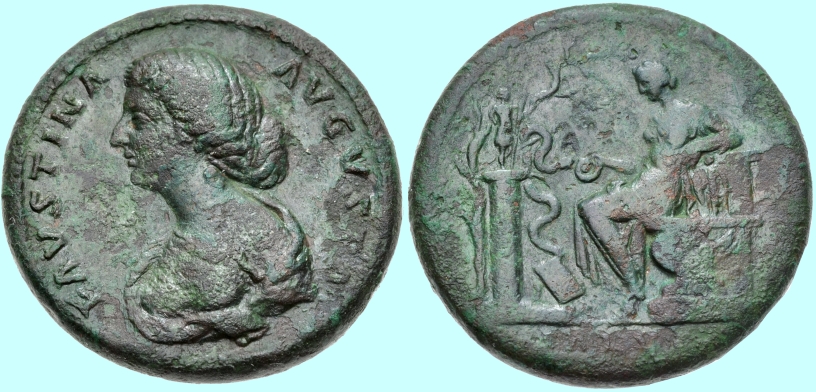
Classical
Numismatic Group Auction 85 Auction date: 15
September 2010 Lot number: 928 Estimate: 5000 USD
Price realized: 4,600$ (Note: Prices do not
include buyer's fees). Lot description: Faustina
Junior. Augusta, AD 147-175. Æ Medallion
(37mm, 41.45 g, 12h). Rome mint. Struck under
Marcus Aurelius, AD 161-175. FAVSTINA AVGVSTA,
Bareheaded and draped bust left / SALVS in
exergue, Salus seated left on throne, adorned by
sphinx and griffin, feeding snake uncoiling from
branch; to left, column surmounted by statuette.
Gnecchi II 3, pl. 67, 3 = Banti 103 (same dies as
illustration); MIR 18, 1002-1/20. VF, rough green
and red-brown surfaces. Extremely rare. To the
Romans, Salus was the personification of health
and the equivalent of the Greek goddess, Hygieia,
the daughter of the Greek god of healing,
Aesculapius. As such, the role of Salus, like
Hygieia, was preventative rather than restorative
- she was associated with the prevention of
sickness and the continuation of good health -
both physical and mental. Consequently, her
presence on Roman imperial coinage may be taken as
the possible indication of the recovery of the
imperial person from some bout of illness or
indisposition or, as in the case of Faustina
Junior, the recovery from the process of
childbirth. Originally betrothed by her parents,
Antoninus Pius and Faustina Senior, to Lucius
Verus, Annia Galeria Faustina Minor was
subsequently married to Marcus Aurelius in AD 145.
Over the next twenty-one years, she produced
thirteen children, including the rare birth of two
sets of twins - T. Aelius Aurelius and T. Aurelius
Antoninus in AD 149 (both subsequently dying
before the year was out), and T. Aurelius Fulvus
and the future emperor L. Aurelius Commodus in AD
161. Of all her offspring, only three - Lucilla,
Cornificia, and Commodus - survived to adulthood.
Such repeated pregnancies, even for a woman in the
imperial household, were fraught with danger, but,
given the number of births which failed to reach
adulthood, was necessary in the drive to produce
an imperial heir. Faustina’s recovery from
childbirth would have been of prime concern for
the empire, if she needed to be called upon once
again to produce a possible heir.
|
||
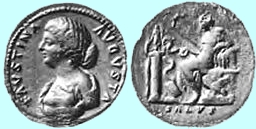
| Una descrizione di
questo medaglione, unitamente ad un'immagine
fotografica, è presente in una
pubblicazione dello Gnecchi del 1891 dal titolo
"Monete inedite del Museo Comunale di Trento" (v.
link).
Lo Gnecchi parla in termini giustamente
entusiastici della "scoperta" museale, così
riferendo: "questo magnifico medaglione è
certamente il pezzo più importante del
Museo di Trento, quantunque la conservazione
eccellente al dritto, lasci qualche cosa a
desiderare nel rovescio. Il busto di Faustina
è forse il più artistico di quanti
si vedono sui medaglioni di questa imperatrice
(Vedi i diversi medaglioni riportati nell’opera
del Froehner: Les Médaillons de l’Empire
Romain). Il rovescio ci offre per la prima volta
la rappresentazione della Salute, sconosciuta
finora sui medaglioni di Faustina giovane, mentre
è abbastanza frequente su quelli di
Marc’Aurelio." Di seguito riporto la descrizione del medaglione tratta dalla pubblicazione anzidetta:
FAUSTINA juniore. 38. Medaglione di Bronzo. — Dopo Coh. 100. D/ — FAVSTINA AVGVSTA Busto a destra.1 R/ — SALVS (all’esergo). La Salute seduta a sinistra tiene nella destra una patera in atto di nutrire un serpente, che si stacca da un albero, presso al quale v’è una colonnetta sormontata dalla statua di Roma; a suoi piedi uno sgabello (?).Tiene il gomito appoggiato al seggio, sul quale vedesi effigiata la statua della Speranza. Nella parte inferiore del seggio, griffo alato. Diam. mill. 39. Peso gr. 49,90. (Tav. XVII, N. 3 della Rivista Italiana di Numismatica, Anno IV, 1891). (1) In realtà il busto nella foto è a sinistra e non a destra. |
||
|